Our own software · built and owned by Mind Links
Finding the file nobody can find.
A searchable catalogue over drawings, surveys and reports too heavy to email, with rules about who may open what and a record of who did.
- Sector
- Engineering, surveying, construction, legal
- The problem size
- Anything past roughly ten thousand files
- Type
- Catalogue and entitlement over heavy assets
- First release
- One month
01 — The problem
The file exists. That is not the same as having it.
An engineering or surveying business accumulates tens of thousands of drawings, site surveys, test reports and as-built records. They sit on a network drive in folders named after projects that were renamed twice, or in an archive whose index is a person.
So the work is redone. A survey is commissioned for a site that was surveyed in 2021, because finding the 2021 one would take longer than paying for a new one. That is a real decision people make, and it is always the wrong one by a factor of ten.
Search by filename finds nothing, because nobody names a file with the thing you will later need to search by.
02 — The system
Search by attribute, not by folder
The catalogue holds what the file is about: location, project, discipline, date, revision, client, status. The file stays where it is. What changes is that it becomes findable by the terms an engineer actually has in mind.
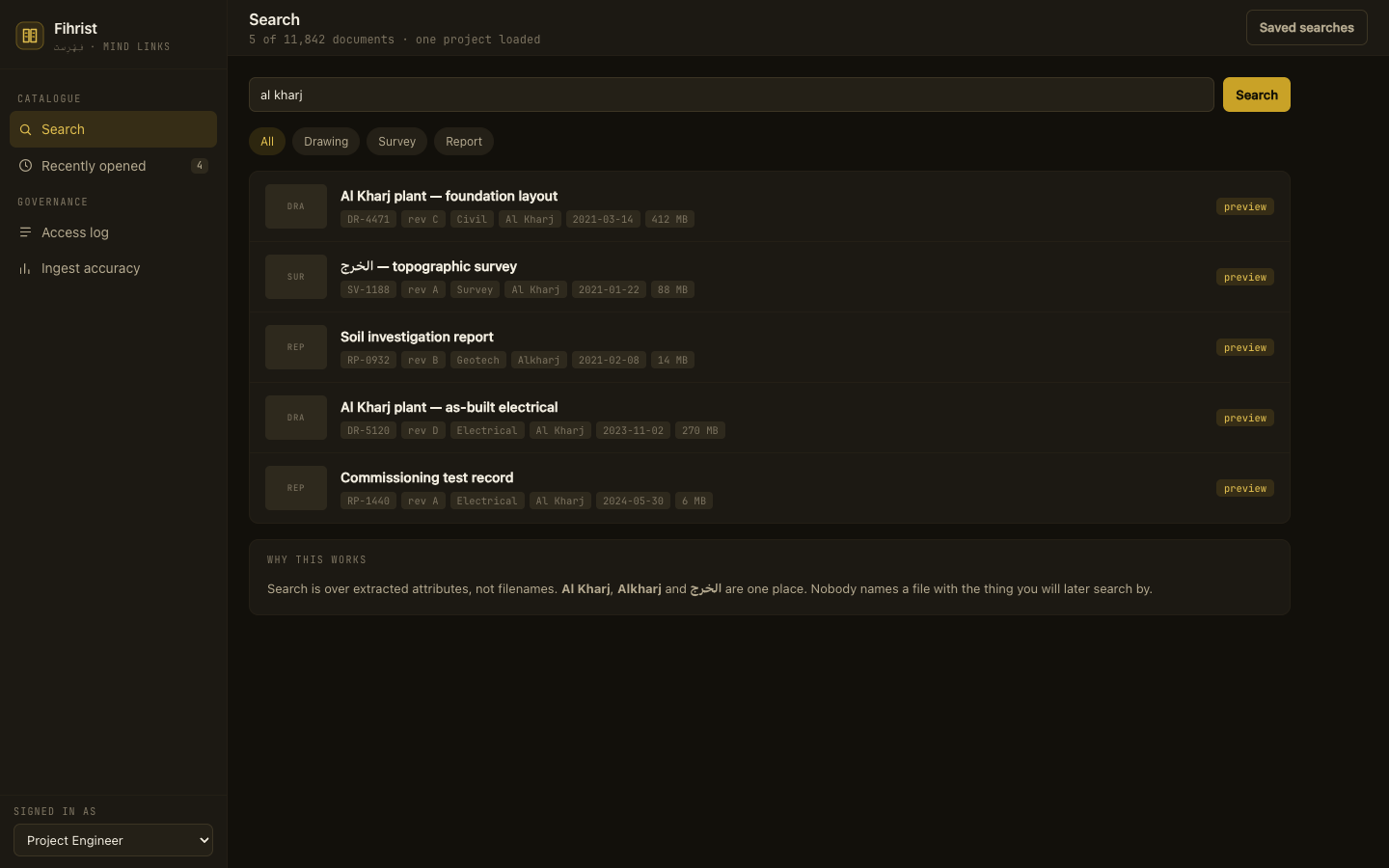
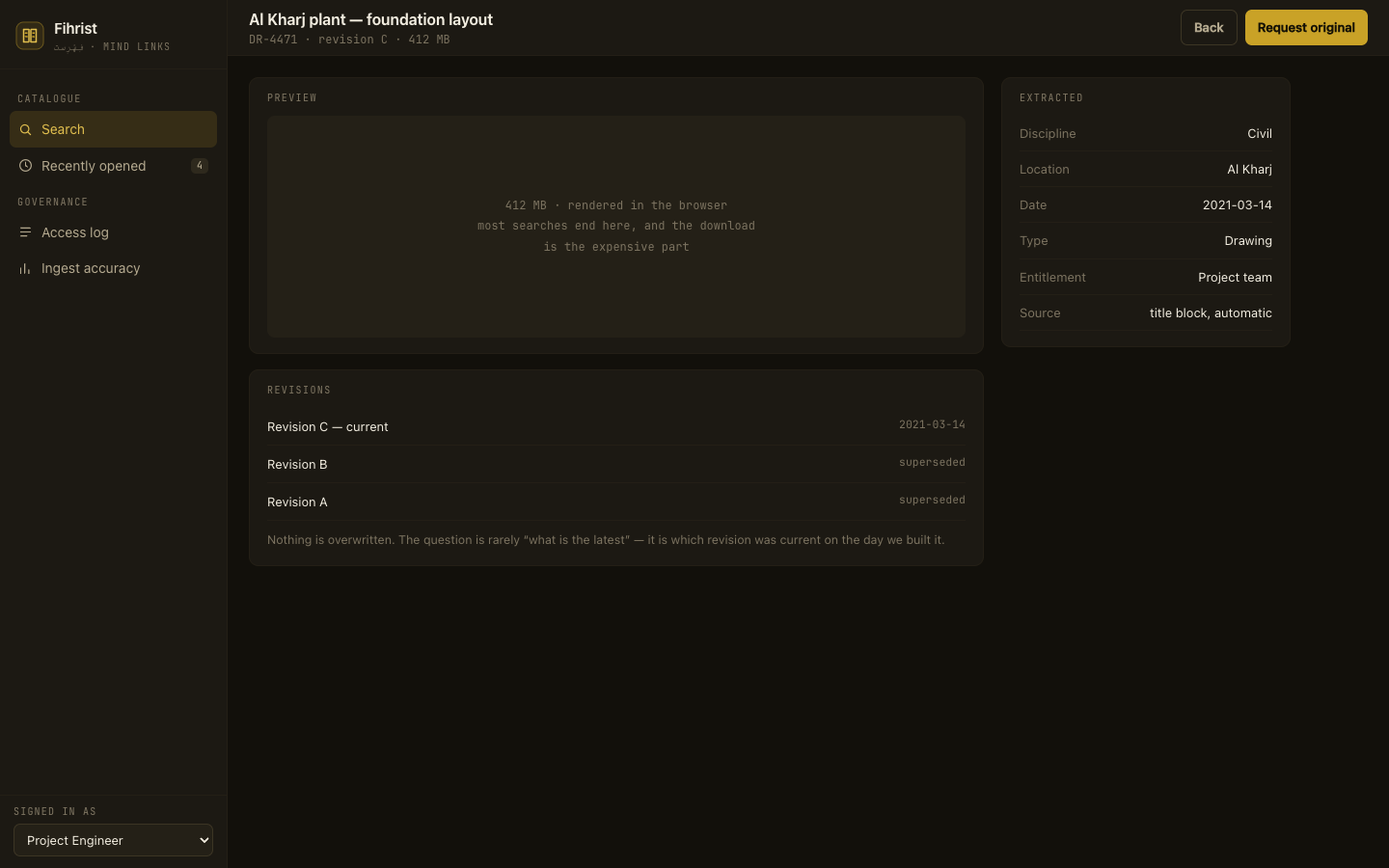
Screenshots of Fihrist, a working prototype we wrote for this page. It runs, every figure in it is invented, and we will click through it in a meeting.
The metadata comes out of the document
Title blocks on drawings, headers on reports, coordinates in survey files. Extracted once on ingest, corrected by a person where it matters. Asking people to fill a form for ten thousand legacy files is how these projects fail.
Preview without downloading
A 400 MB drawing set opens as a preview in the browser. Most searches end at the preview, which is the point — the download is the expensive part.
Entitlement is part of the record
Client-confidential work, work under NDA, work for a competitor of the person asking. Who may open what is a property of the document, not of the folder it happens to sit in.
Access is logged, permanently
Who opened which document and when. When a client asks whether their drawings were ever shared outside the project team, that question has an answer.
Revisions, and which one was current
Every document keeps its versions and its supersedes-chain. The question is rarely “what is the latest revision”. It is “which revision was current on the day we built it”, and only a system that never overwrites can answer that.
03 — The Saudi part
Where the files are allowed to live
Two constraints shape this more than anything technical.
- Data residency. Survey data, site records and anything containing personal data has to sit where PDPL and your client contracts allow. That decides the hosting before it decides the software, and we agree it in writing before the first file moves.
- Bilingual documents and bilingual search. Drawings titled in English, reports written in Arabic, project names transliterated three different ways. Search that does not handle Al-Kharj, Alkharj and الخرج as the same place is search that does not work here.
Add to that the ordinary reality that the archive spans two or three eras of naming convention, at least one company merger, and a period when everything went into a folder called New Folder (2).
Built with, and where it runs
- Oracle Cloud · Jeddah
- Object storage in-Kingdom
- Arabic and transliteration matching
- DWG, DGN, PDF preview
- Immutable access log
The highlighted regions are live in the Kingdom today. Hosting is settled before the software is, because PDPL and your own client contracts settle it — not us.
04 — What we would build first
One month, one discipline, one site
In the first month
- One project’s archive ingested, metadata extracted automatically
- Search by location, date, discipline and revision
- Preview in the browser, no download
- An honest report on what the extractor got wrong, because that number decides the rest of the project
Deliberately not yet
- The whole archive
- Entitlement rules and access logging
- Arabic and transliteration matching
- Anything that moves or deletes an original
The extraction accuracy on one real project tells you whether this is a two-month job or a two-year one. Nobody can estimate it from the outside, and any vendor who quotes the whole archive without measuring first is guessing with your money.
Whose software this is
Ours. Designed, written and owned by Mind Links. No client, no real archive.
Our engineers have built catalogue and entitlement systems over very large technical archives for international operators. Those systems belong to those operators and nothing from them is here. What carries over is knowing that the project is decided by metadata extraction accuracy, and that it must be measured before it is quoted.