Our own software · built and owned by Mind Links
One question, forty branches.
An operations assistant scoped to a branch, a role and a period, so a regional manager stops phoning around to build a picture that already exists.
- Sector
- Multi-branch retail, clinics, restaurants, rental
- Company size
- Ten branches upward
- Type
- Assistant over operational data, scoped by permission
- First release
- One month
01 — The problem
The data exists. Getting an answer takes two days.
A regional manager wants to know which branches missed target last week and why. The sales figures are in one system, staffing in another, stock in a third, and the why is in the head of a branch manager who will answer the phone this afternoon.
So they call four people, assemble it in a spreadsheet, and by the time the picture is complete the week is over.
Reports exist for the questions somebody anticipated. Every real question is the one nobody built a report for.
02 — The system
Ask in words. The permission model does the rest.
The assistant is scoped before it answers. A branch manager asking about staffing gets their branch. A regional manager gets their region. Nobody sees another branch's payroll because they phrased the question cleverly — scope is enforced at the data layer, not in the prompt.
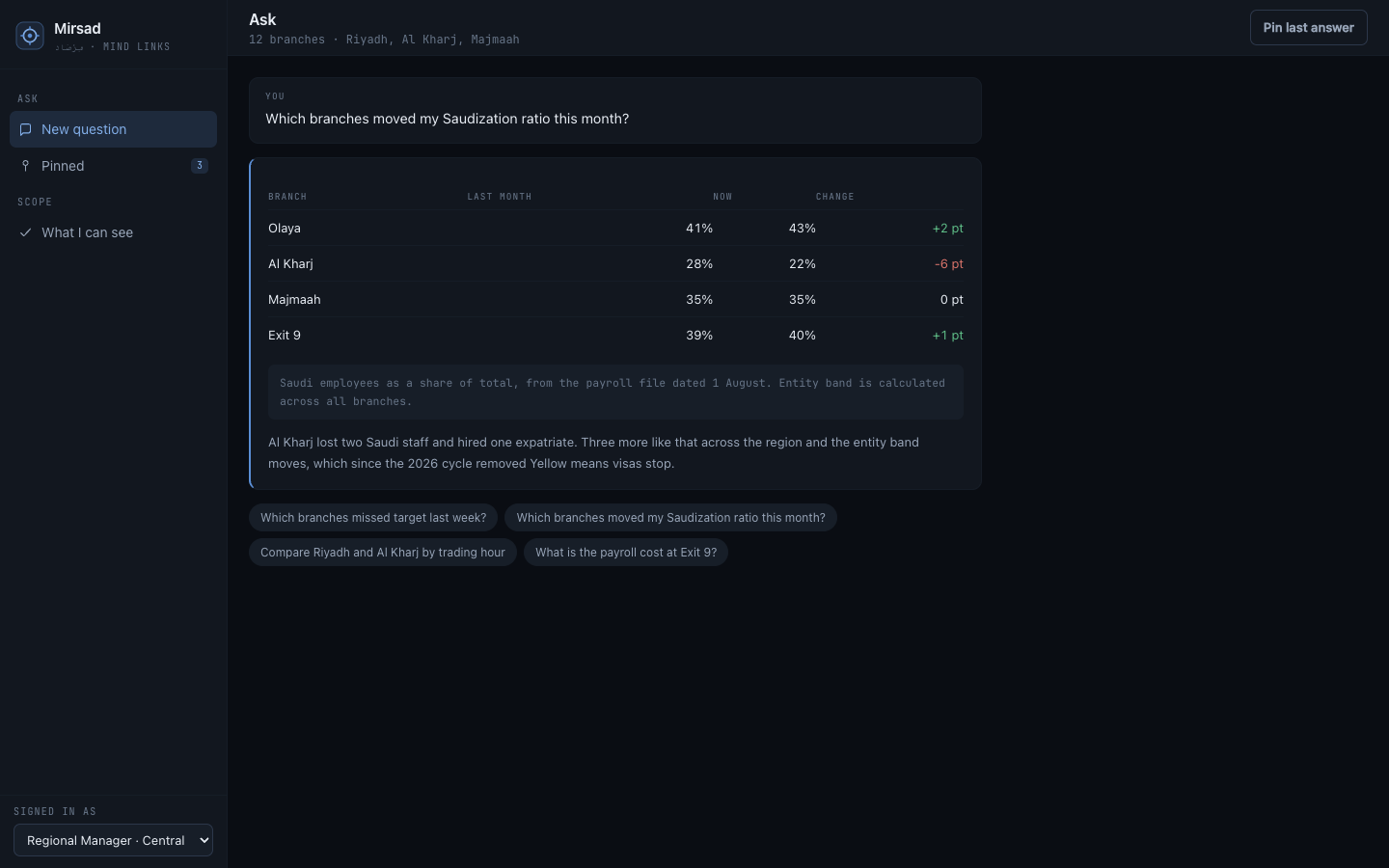
Screenshots of Mirsad, a working prototype we wrote for this page. It runs, every figure in it is invented, and we will click through it in a meeting.
It shows the query, not just the number
Every answer comes with what it counted and over which period. A number without its definition starts an argument in the next meeting, and the argument is about the tool instead of the branch.
It says when it does not know
If the answer needs data that is not connected, it says which system it is missing rather than approximating from what it has.
Follow-ups keep the context
“And the month before?” “Just Jeddah?” “Same but excluding the new branch?” That conversation is the actual work; a dashboard cannot have it.
Answers become saved questions
Anything asked three times becomes a pinned question on the branch page. The assistant gradually builds the dashboard nobody could specify in advance.
03 — The Saudi part
Two things every multi-branch operator here is watching
- Saudization by branch, not by company. The Nitaqat band is calculated at entity level, but the risk is created branch by branch as people join and leave. A regional manager who can ask “which branches moved my ratio this month” can act before the band slips, and slipping now costs visas and permit renewals since the Yellow band was removed in the 2026 cycle.
- Prayer times and the working day. Footfall, staffing and delivery windows all bend around them, and they differ by city. Any comparison between branches that ignores that is comparing the wrong hours.
Then the ordinary ones: Sunday to Thursday, Ramadan trading patterns that look like a data error if you have not seen them before, and Arabic branch names that are spelled three ways across three systems.
Built with, and where it runs
- Google Cloud · Dammam
- Row-level scope by branch and role
- Prayer-time aligned periods
- Qiwa headcount feed
- Read-only connectors
The highlighted regions are live in the Kingdom today. Hosting is settled before the software is, because PDPL and your own client contracts settle it — not us.
04 — What we would build first
One month, one system, five questions
In the first month
- One data source only — usually sales
- The five questions your regional managers actually ask, from asking them
- Scope enforced by role and branch
- Every answer showing its query
Deliberately not yet
- Staffing, stock and finance systems
- Free-form questions across everything
- Alerts and anomaly detection
- Anything that writes back
One source answered exactly is trusted. Three sources answered approximately is abandoned in a fortnight, and you do not get a second attempt at credibility.
Whose software this is
Ours. Designed, written and owned by Mind Links. No client behind it and no real branch data.
Our engineers have built assistants scoped to organisational hierarchies for large operators. Those systems belong to those operators and nothing from them is here. What carries over is that the hard part is the permission model, not the language.