Our own software · built and owned by Mind Links
Every contractor approved,
every certificate still valid.
A stage-gate approval system for companies that work through subcontractors: one queue, mandatory documents at each gate, a signature against every decision, and an alarm before a compliance certificate expires.
- Sector
- Contracting, facilities management, logistics
- Company size
- 50–500 staff, 20–300 subcontractors
- Type
- Internal operations system
- First release
- One month
- Languages
- Arabic and English, full right-to-left
01 — The problem
The approval nobody owns
A contracting company with 120 subcontractors carries roughly 700 documents that expire. Commercial registration, VAT certificate, GOSI subscription, Saudization certificate, insurance, bank letters. Each on its own date, none of them in the same place.
Approving a new subcontractor takes six people and lives in email. Somebody in procurement collects the file, somebody in HSE checks the safety record, finance checks the bank details, legal checks the contract. There is no queue, so the only way to know where a request is, is to ask.
The expensive failure is not the slow approval. It is the crew that turns up on site on a Sunday morning and cannot work, because a certificate expired eleven days ago and the renewal email went to someone who left.
- Nobody can answer “where is it?”A request sits in an inbox. The person is on leave. There is no record that it ever arrived.
- Documents arrive incompleteHalf the back-and-forth is chasing a page that was always going to be required.
- Expiry is discovered, not predictedA spreadsheet somebody maintained until they changed role.
- No defensible audit trailWhen a client or an auditor asks who approved this contractor and on what basis, the answer is a search through mailboxes.
- Approvals are unevenly appliedA well-connected supplier moves in two days, a new one waits five weeks. Nobody intended that.
- Renewals repeat the whole processThe same file is rebuilt every year because last year’s was never structured.
02 — The system
One queue, five gates, a signature on each
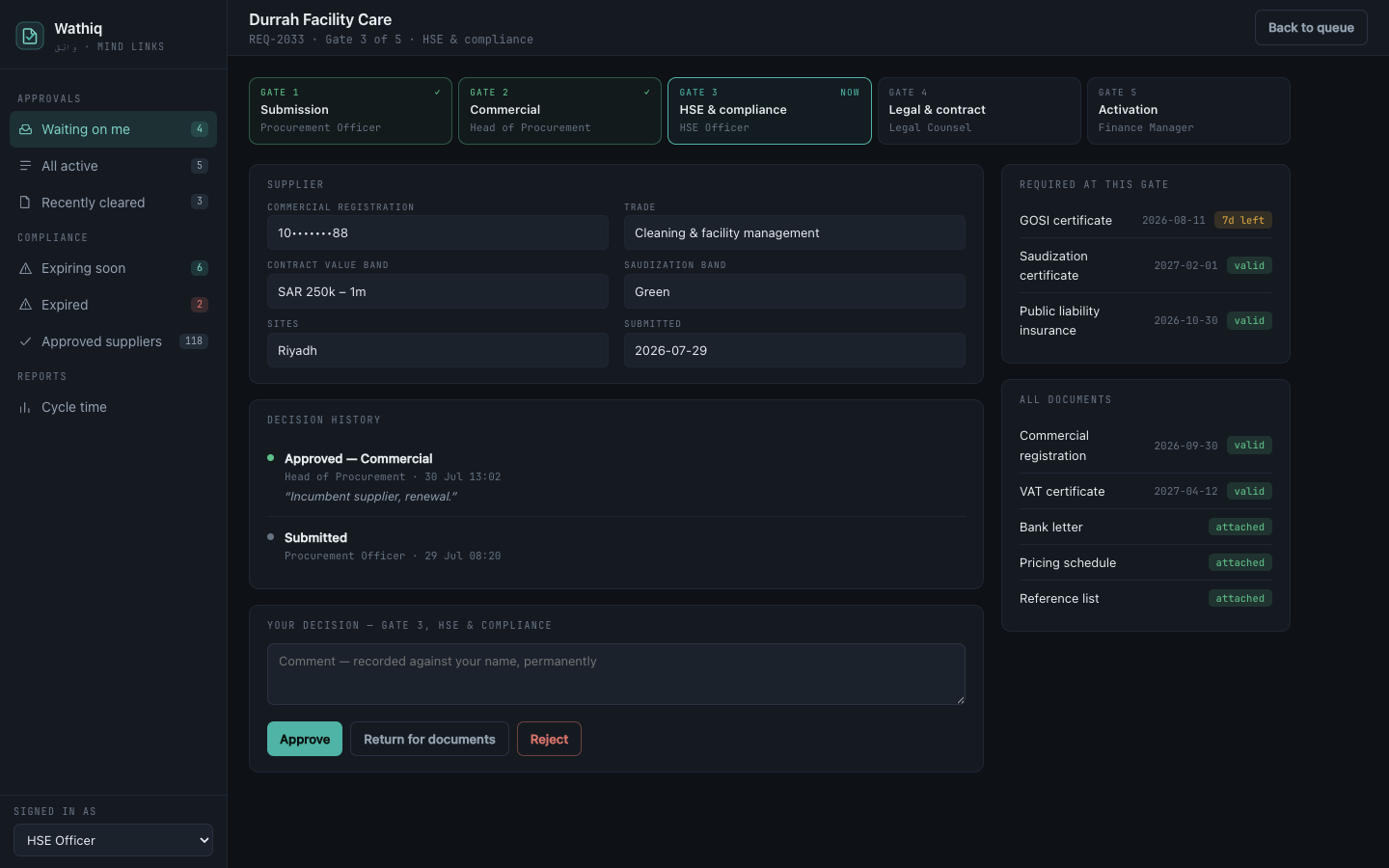
Nothing moves to the next stage until the documents that stage requires are attached and the named approver has signed. The stage a request sits in is the only status there is, so the question “where is it?” has one answer and everybody can see it.
Gates are configurable per company. A logistics operator replaces HSE with fleet and driver licensing; the mechanism does not change.
The queue
Everybody opens the same list. It is filtered to what is waiting on you, because a queue that shows everything is a queue nobody reads.
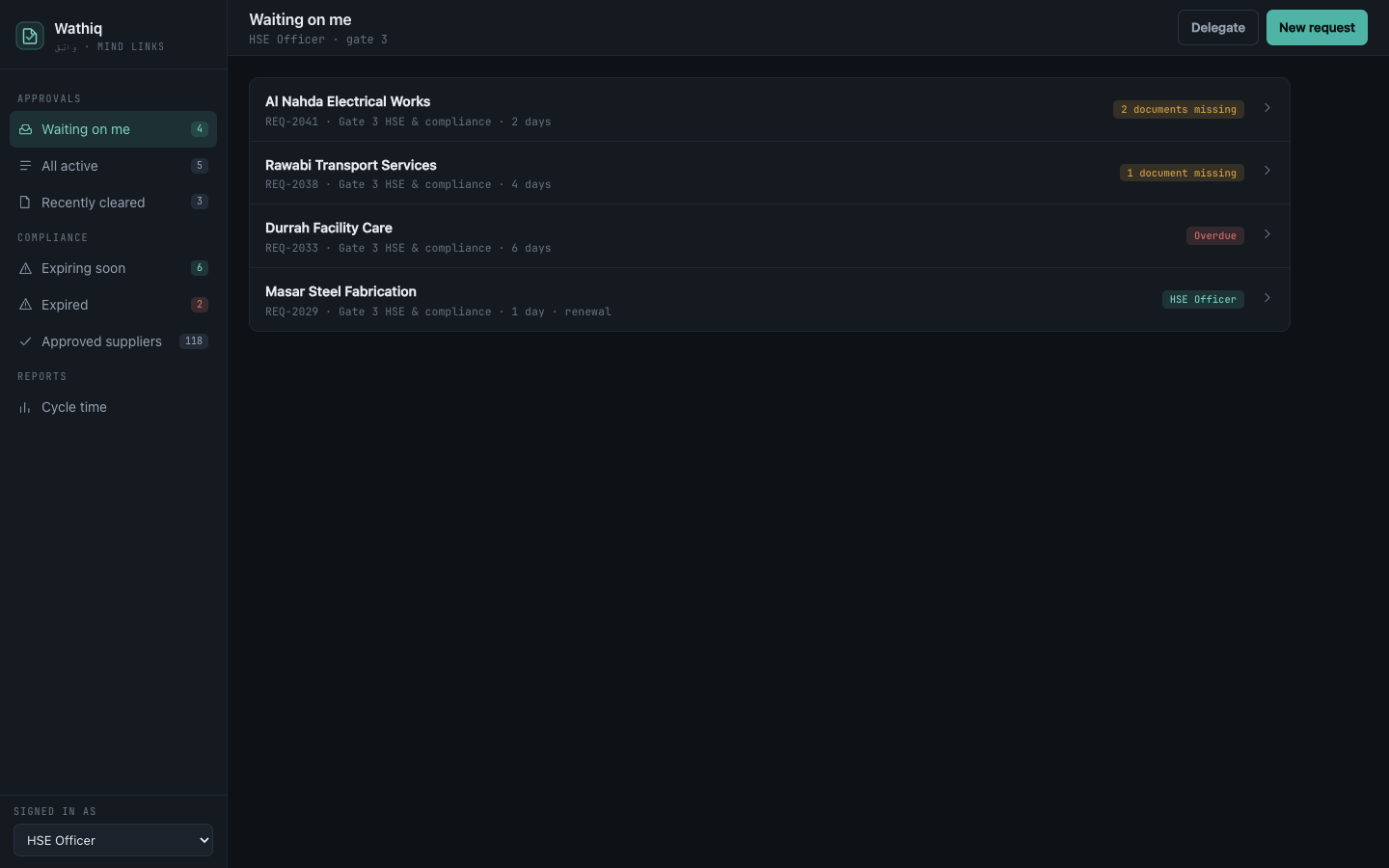
The request, and who signed what
An approver sees the file read-only, the documents, the position in the flow, and every decision taken before theirs. They approve or reject with a comment. There is no third option, and no way to move it forward without one.
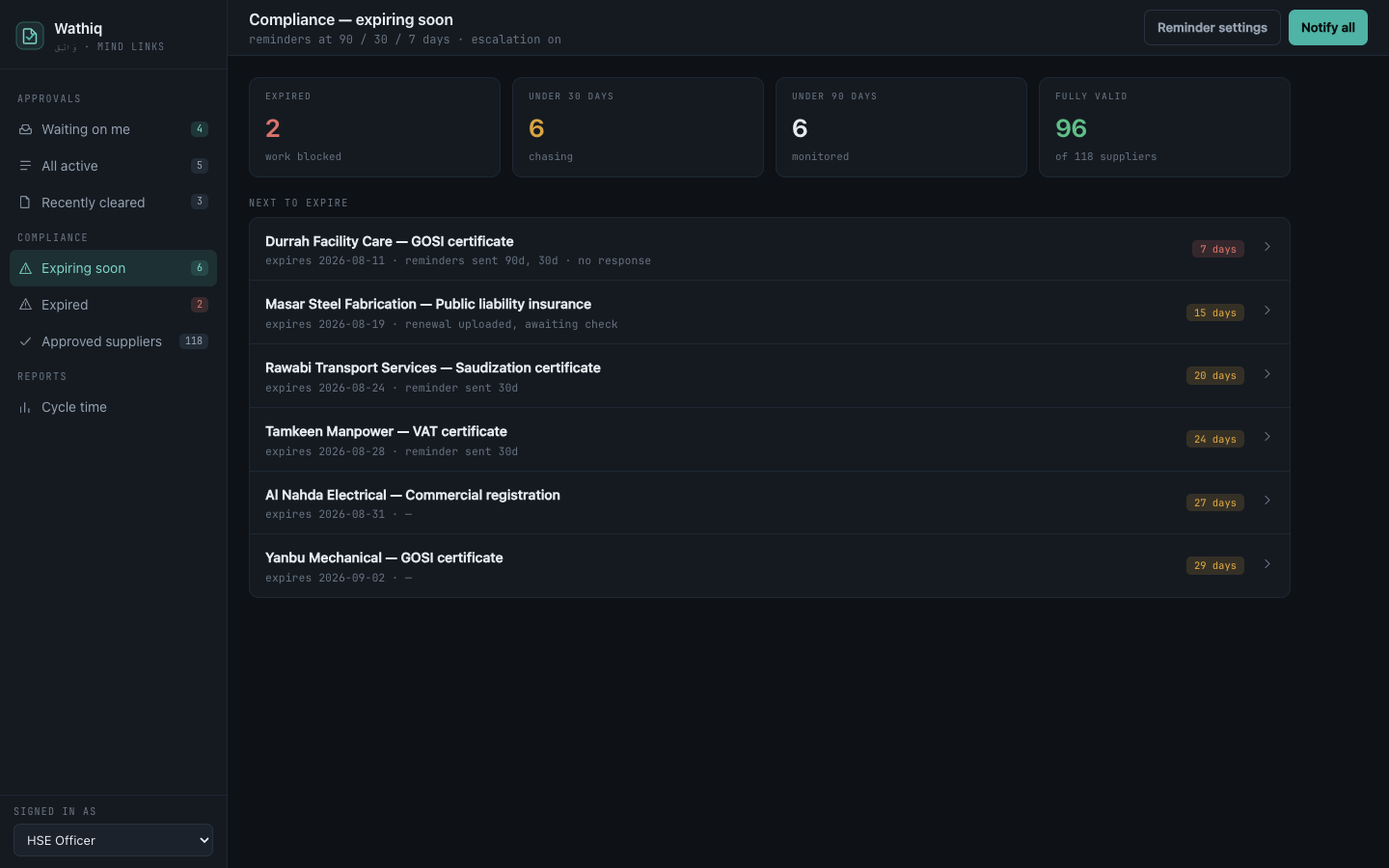
The board that prevents the Sunday morning
Every certificate carries its expiry date from the moment it is uploaded. The system counts down and tells the supplier and the owner, on a schedule agreed once, rather than when somebody notices.
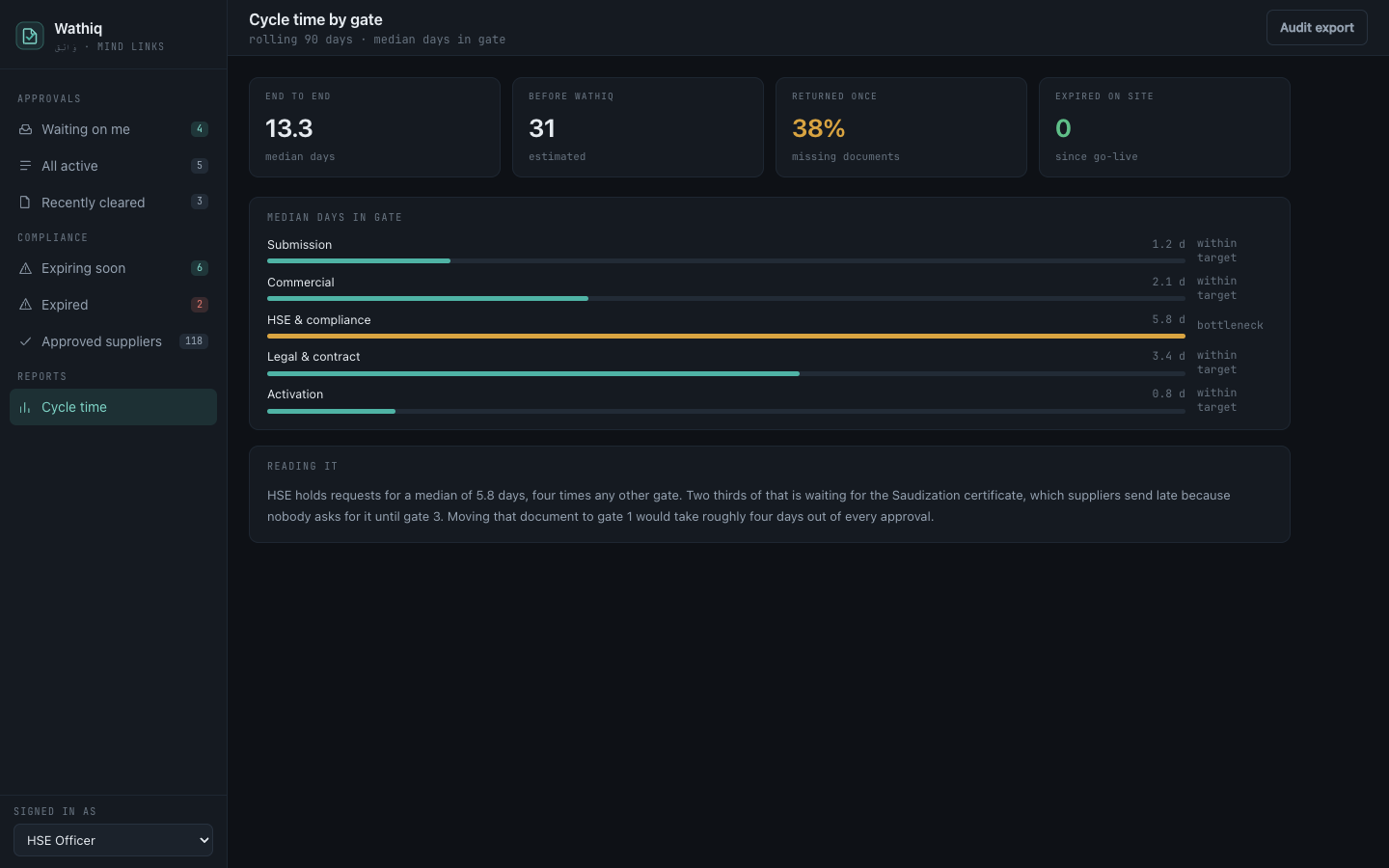
What it tells the manager
The queue produces its own measurement. Once every decision carries a timestamp, the question “why does approving a supplier take a month?” stops being a matter of opinion.
These are screenshots of a working prototype built by Mind Links for this page. Every supplier, certificate and figure in it is invented. It runs — ask to click through it.
03 — Why this is a Saudi system, not a translated one
The documents are the whole problem
A generic vendor-management product handles a supplier record and an attachment. It has no opinion about which attachments matter, when they expire, or what happens when one does. In this market that is the entire job.
| Document | Why it gates the approval | Renewal behaviour |
|---|---|---|
| Commercial registration | Confirms the supplier legally exists and may trade in this activity | Annual. Blocks activation while lapsed |
| VAT certificate | Needed before an invoice can be accepted. A wrong-year certificate is the single most common return | Checked against the ZATCA registration number on submission |
| GOSI subscription | Evidence that the workers on your site are actually registered employees | Monthly currency check; expiry blocks new work orders |
| Saudization certificate | Nitaqat band. A supplier that slips to Red cannot renew work permits, which becomes your delivery problem | Band recorded, not only the certificate. A change of band raises an alert |
| Insurance | Public liability and workers’ cover. The document your own client will ask you for | Expiry suspends the supplier and holds open work orders |
| Bank letter | Payment details verified once, in writing, against the CR name | Any change re-enters the approval flow. This is where invoice fraud enters |
Arabic first, not Arabic later
The people who upload documents and answer the reminders are often not the people who read English. The interface, the notifications and the exported audit report are all bilingual, and the Arabic is built right-to-left rather than mirrored at the end.
Built for the working week
Sunday to Thursday. Reminder and escalation schedules understand the Saudi week, Ramadan hours and the Eid holidays, because a seven-day warning that lands on a Thursday evening is not a warning.
PDPL by construction
Supplier files hold personal data: identity documents, names, salaries in a GOSI extract. Data location, retention and who can open an attachment are set before the first upload. PDPL is enforced, with penalties reaching SAR 5,000,000 per violation, and the liability sits with the company holding the file.
An audit export that ends the conversation
One PDF per supplier: every document, every version, every approval with a name, a timestamp and a comment. Produced in a click when a client, an insurer or an auditor asks how this contractor came to be on site.
04 — Underneath
What makes it hold up
Configurable gates, not hard-coded ones
Stages, required documents and approver roles are data. A new gate is a configuration change made by the client, not a release by us.
Role routing with real delegation
Approvals route to a role, not a person, so annual leave does not stop the queue. Delegation is explicit and recorded.
An append-only decision log
Nothing in the history can be edited or removed, including by an administrator. That property is what makes the export worth anything.
Documents versioned, never replaced
Uploading a renewal keeps the old file. “What was valid on the day we let them on site?” stays answerable.
Notifications people actually receive
Email and WhatsApp, in the recipient’s language, with escalation when a gate goes past its agreed time.
It connects to what you run
An approved supplier becomes a vendor record in the ERP, with the supplier code written back. No re-keying, which is where the errors come from.
Built with, and where it runs
- Google Cloud · Dammam
- ZATCA VAT registry lookup
- GOSI · Saudization certificate
- WhatsApp Business API
- Append-only decision log
- Arabic and English, full RTL
The highlighted region is live in the Kingdom today. Hosting is settled before the software is, because PDPL and your own client contracts settle it — not us.
05 — What we would build first
One month, one gate, real suppliers
Not the whole system. The narrowest slice that changes somebody’s Sunday.
In the first month
- The document register for your existing suppliers, loaded from whatever you have now
- Expiry dates captured, with the 90 / 30 / 7 day reminder schedule running
- The expiring-soon board, live, on a phone
- Bilingual notification templates you approve before we send anything
Fixed price, agreed before the work starts. Source code in your repository from the first commit.
Deliberately not yet
- The full five-gate approval flow
- ERP write-back
- The supplier-facing upload portal
- Reporting beyond the one board
Those follow once the register is real and populated. A workflow over data nobody trusts is a workflow nobody uses.
The reminder schedule alone usually pays for the engagement, and it is the part that takes one month rather than two quarters.
Whose software this is
Built by Mind Links to show how we approach a problem we have seen in several Saudi companies. It is real, running software that we own. It is not a delivered client project, and there is no client behind it.
The screenshots are of a working prototype we wrote for this page. It is real software and we will open it in a meeting, but it is a demonstration rather than a product: no persistence, no authentication, and every supplier, certificate and number in it is invented. Any resemblance to a real supplier is accidental.
We label concepts as concepts. When we have delivered client work and hold written permission to describe it, that will be a different page and it will say so plainly at the top.