Our own software · built and owned by Mind Links
A pipeline for a product that needs a site visit.
Most CRMs assume the deal closes on a call. This one is built around the survey, the quote that depends on it, and the engineer who has to drive there.
- Sector
- Distribution, equipment, telecoms, solar, security systems
- Company size
- A sales team of five to forty, plus field engineers
- Type
- Pipeline built around a physical constraint
- First release
- One month
01 — The problem
The bottleneck is not the salesperson
If your product needs someone to visit before it can be quoted — a rooftop measured, a panel inspected, a route walked, a signal tested — then the constraint on revenue is survey capacity, not pipeline size. Generic CRMs model neither.
So the pipeline fills, the surveys queue, quotes go out three weeks late, and the sales team is told to prospect harder.
The deal did not go cold. It waited eighteen days for a two-hour visit, and nobody was measuring that.
- The survey is a phone callBooked between a coordinator and an engineer, invisible to everyone else.
- The engineer’s notes never arrivePhotographs on a personal phone, measurements on paper, both re-entered later or lost.
- Quotes are rebuilt from memoryTwo days after the visit, when the detail has gone.
- Routing wastes half a dayTwo surveys in the same district on different days, and one in Jeddah on a Tuesday.
- Nobody knows the real conversionNot lead to sale — survey to sale. That is the number the business runs on.
- The customer is never told anythingThey chase, which costs the coordinator more time than telling them would have.
02 — The system
The survey is the object, not a note on a deal
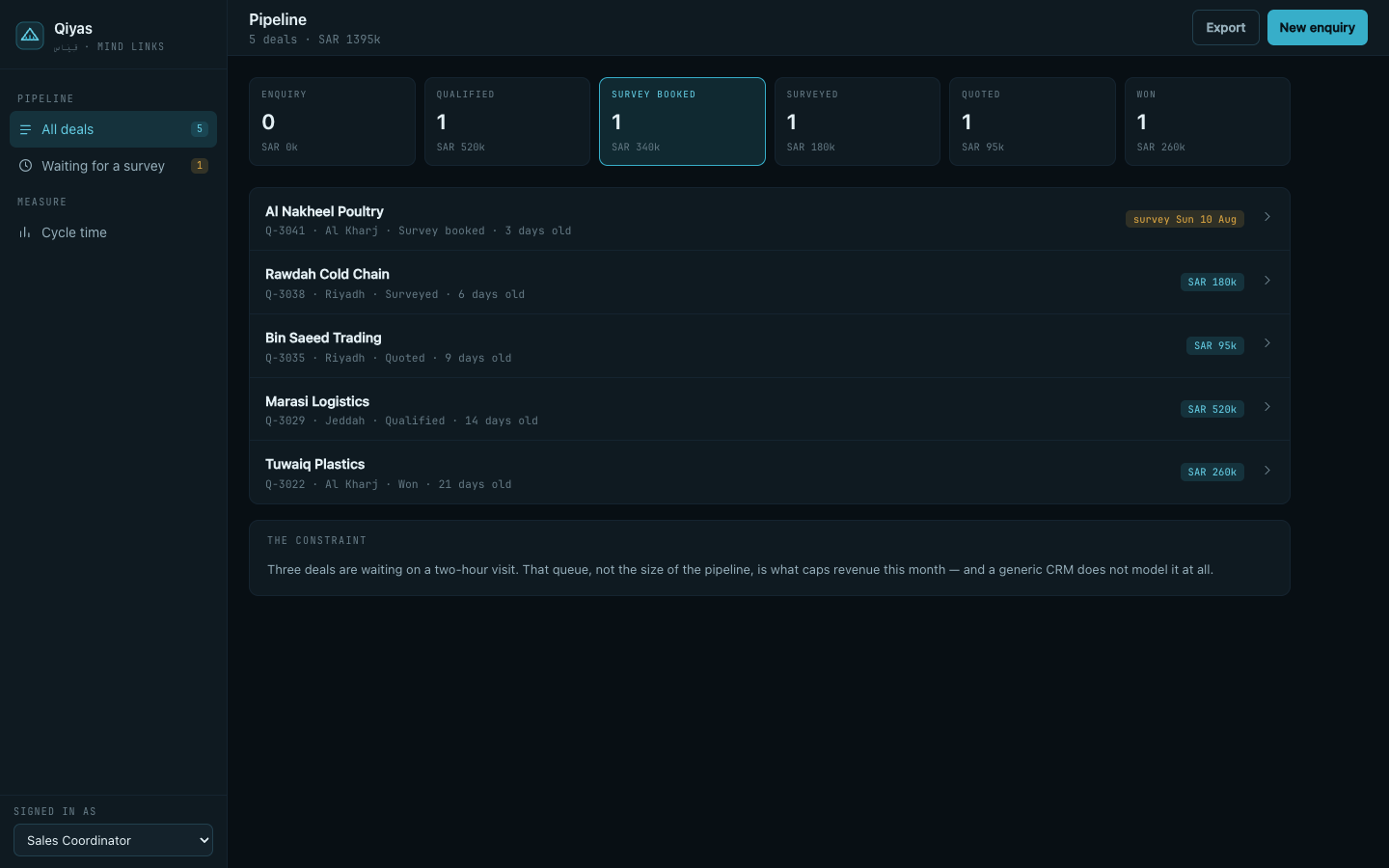
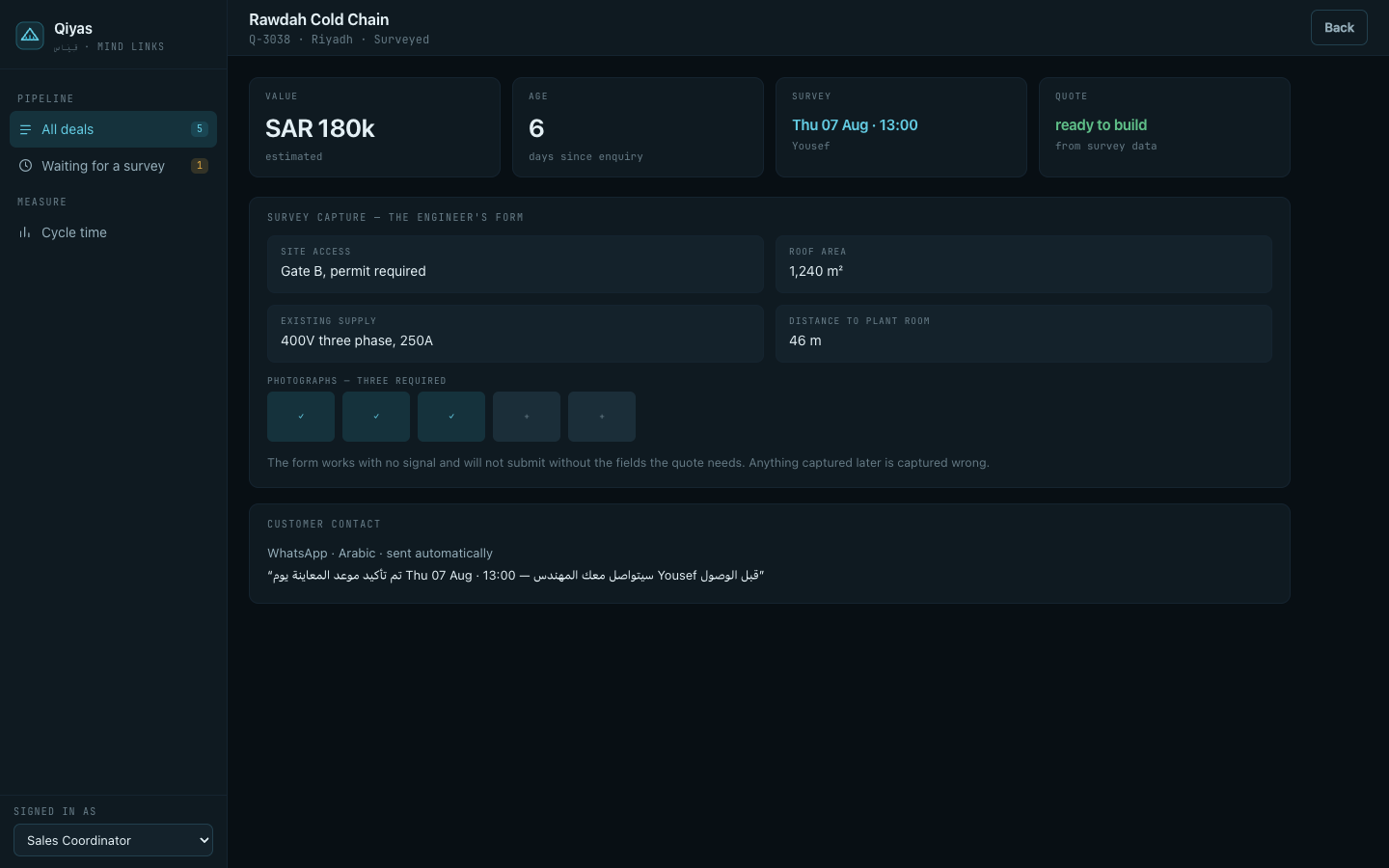
Screenshots of Qiyas, a working prototype we wrote for this page. It runs, every figure in it is invented, and we will click through it in a meeting.
Capture happens on site or not at all
The engineer’s form is short, works with no signal, and will not submit without the three photographs and two measurements the quote needs. Anything captured later is captured wrong.
The quote is assembled, not written
Survey fields feed the pricing directly. The salesperson adjusts and sends, usually the same day, and the version the customer received is stored exactly as sent.
Routing by district and day
Surveys group geographically before they are offered as slots, which is the difference between four visits a day and two.
Two numbers on the wall
Days from enquiry to survey, and survey to quote. Everything else in the funnel is downstream of those, and almost nobody measures either.
03 — The Saudi part
Where the deal actually lives
- WhatsApp is the channel, not email. The booking confirmation, the engineer-is-on-the-way message and the quote link go there, in Arabic, or they are not read.
- Sunday to Thursday, and the seasons that break it. Ramadan hours change what a survey day holds. Summer afternoons change what a rooftop survey holds.
- Quotes in SAR with VAT stated, and the ZATCA-compliant invoice generated from the same accepted quote rather than retyped into the accounting system.
- Site access is a real stage. On industrial and government sites a survey needs a permit and an ID, and the visit fails without them. That belongs in the workflow, not in a coordinator’s head.
Built with, and where it runs
- Google Cloud · Dammam
- WhatsApp Business API
- National Address · SPL
- Moyasar or HyperPay · SAMA-licensed
- Offline-first capture
The highlighted regions are live in the Kingdom today. Hosting is settled before the software is, because PDPL and your own client contracts settle it — not us.
04 — What we would build first
One month, the survey loop only
In the first month
- Enquiry to survey to quote, and nothing else
- The engineer’s on-site form, offline-capable
- WhatsApp confirmations in Arabic
- The two cycle-time numbers, from day one
Deliberately not yet
- Full CRM — accounts, contacts, campaigns
- Route optimisation beyond grouping by district
- ERP and accounting integration
- Forecasting
If the survey loop does not get faster, none of the rest is worth building. If it does, the rest pays for itself.
Whose software this is
Ours. Designed, written and owned by Mind Links. No client behind it, and the pipeline in it is invented.
Our engineers have built sales systems for large technical businesses. Those belong to those businesses and none of it is reproduced here. What carries over is the observation that in this kind of company the constraint is survey capacity, and the CRM is usually modelling the wrong thing.