Our own software · built and owned by Mind Links
What happens after the visit.
The job is finished, the consultation is over, and then nothing. This turns a completed appointment into the next specific action.
- Sector
- Clinics, training, professional services, maintenance
- The metric
- Return rate, and it is usually not measured
- Type
- Follow-up automation
- First release
- One month
01 — The problem
The most valuable moment is the one nobody uses
A patient leaves a clinic with a plan. A client finishes a training day with three actions. A customer has an air-conditioning unit serviced and is told it will need a part in six months.
Then the business does nothing, or it sends a generic newsletter, which is worse than nothing because it teaches people to ignore your messages.
Six months later the customer books the part with somebody else, because somebody else asked.
02 — The system
One rule: every follow-up refers to something that actually happened
Not “we hope you enjoyed your visit”. The specific thing: the part that was flagged, the exercise that was prescribed, the document that was promised, the review that was scheduled for eight weeks.
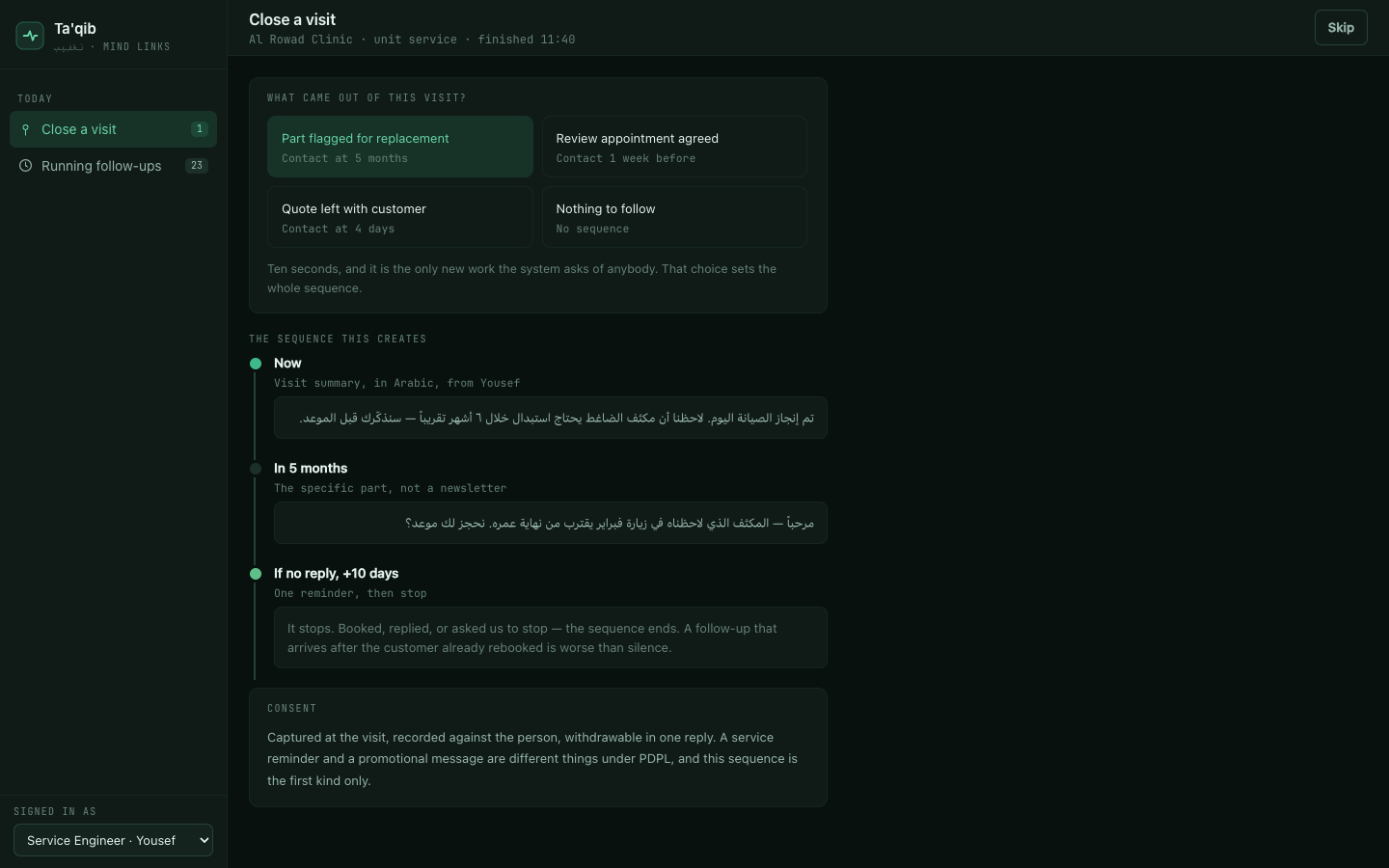
Screenshots of Ta'qib, a working prototype we wrote for this page. It runs, every figure in it is invented, and we will click through it in a meeting.
The visit produces the follow-up
Whoever ran the appointment picks the outcome from a short list at the end of it. That choice sets the sequence. It takes about ten seconds and it is the only new work the system asks of anybody.
Timing from the outcome, not from a calendar
A part due in six months is contacted at five. A course of treatment is followed at the interval the clinician set. Nothing goes out on the first of the month because it is the first of the month.
It stops when it should
Booked, replied, or asked us to stop — the sequence ends. A follow-up that arrives after the customer has already rebooked is worse than silence, and it is the most common way these systems damage a business.
The staff member is visible in it
From the person they actually saw, by name, not from Customer Care. In a relationship market that difference is most of the response rate.
03 — The Saudi part
Channel, language, and a line you do not cross
- WhatsApp, in Arabic, from a business number. Email follow-up in this market is a rounding error.
- Consent is the whole game. PDPL enforcement includes marketing communications sent without a valid basis, and fines reach SAR 5,000,000 per violation. A clinical reminder and a promotional message are different things under the law, and the system treats them differently — consent captured at the visit, recorded against the person, withdrawable in one reply.
- Health data is not marketing data. If the follow-up is clinical, it says what was agreed and nothing about an offer. Mixing the two is both a legal problem and the fastest way to lose a patient.
- Ramadan and Eid change the timing, and a reminder that lands during Iftar is a reminder that annoys.
Built with, and where it runs
- WhatsApp Business API
- Consent register · PDPL
- Hijri-aware scheduling
- Google Cloud · Dammam
- Separate clinical and marketing consent
The highlighted regions are live in the Kingdom today. Hosting is settled before the software is, because PDPL and your own client contracts settle it — not us.
04 — What we would build first
One month, one outcome type
In the first month
- One outcome — the review appointment, or the flagged part
- The ten-second capture at the end of the visit
- One WhatsApp message in Arabic, from the named staff member
- Consent captured and honoured
- The only number that matters: how many came back
Deliberately not yet
- Multiple sequences and branching
- Booking-system integration
- Anything promotional
- Content generated per person
One outcome, measured honestly for a month, tells you whether this is worth building out. Most businesses have never had that number.
Whose software this is
Ours. Designed, written and owned by Mind Links. No client behind it.
Our team has designed follow-up and continuity products for international service businesses. Those concepts belong to those businesses and none of them is reproduced here. What carries over is the rule that a follow-up which does not refer to something that actually happened trains people to ignore you.