Our own software · built and owned by Mind Links
An HR assistant that quotes the policy.
Leave, GOSI, end-of-service, ticket entitlement — answered in Arabic or English, with the clause attached, and a clean route to a human the moment it matters.
- Sector
- Any company past about 200 staff
- Users
- Every employee. HR is the beneficiary, not the user
- Type
- Retrieval assistant over your own policy
- First release
- One month
- Languages
- Arabic and English, both native
01 — The problem
Two people answering the same nine questions
In a company of three hundred, the HR team spends most of its week on questions the policy already answers. How much leave do I have. When does my ticket entitlement reset. What happens to my end-of-service if I resign rather than finish the contract. Is this medical claim covered.
The answers exist. They are in a PDF nobody opens, written in one language, updated last year, and stored somewhere that requires asking HR — which is the loop.
The cost is not the questions. It is that a person who cannot get an answer quickly assumes the worst one, and acts on it.
02 — The system
It answers, and it shows its working
Every answer carries the clause it came from, with a link into the actual document. That single rule changes what the thing is: it stops being a chatbot that might be right and becomes a faster way to read a policy you already have.
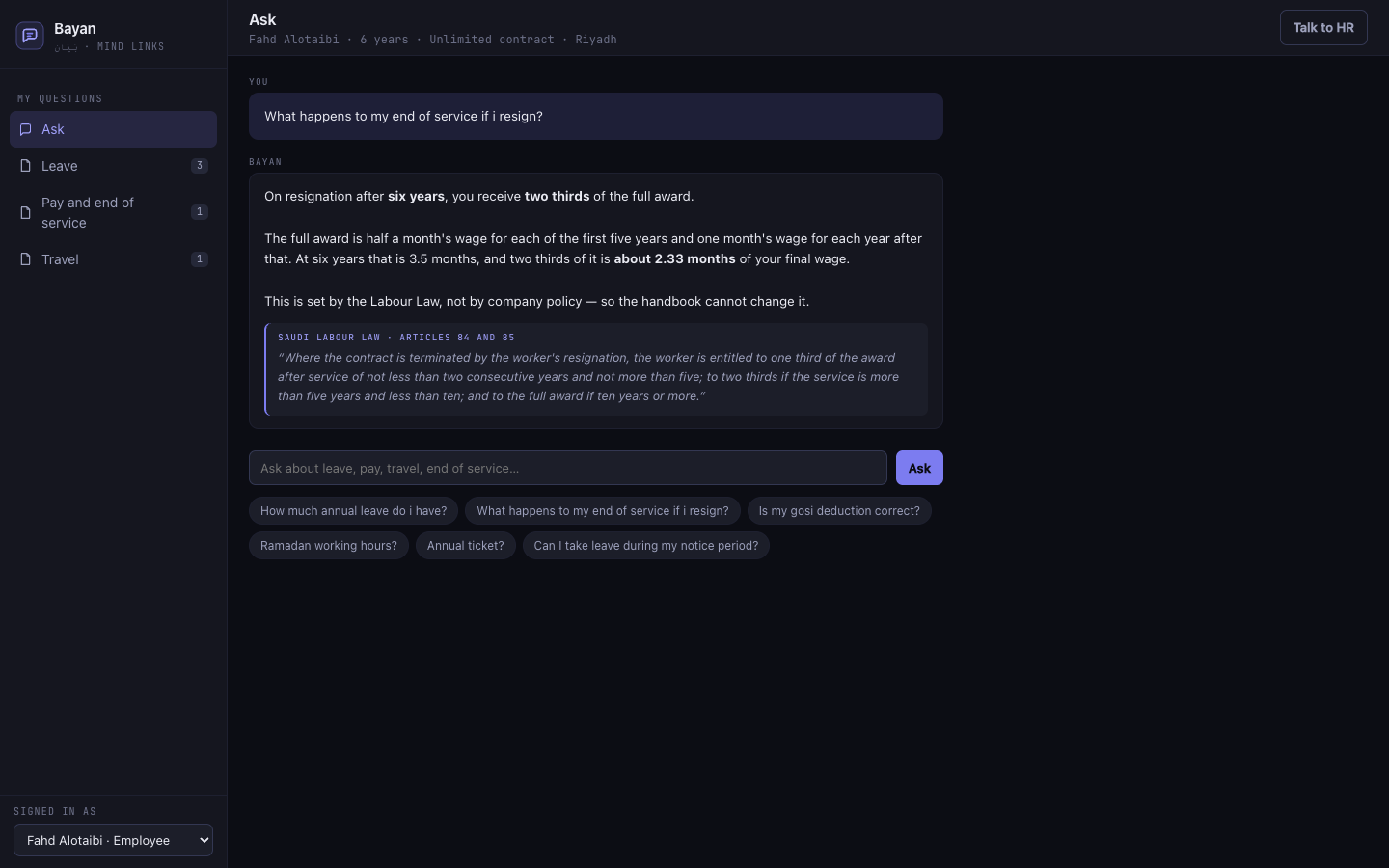
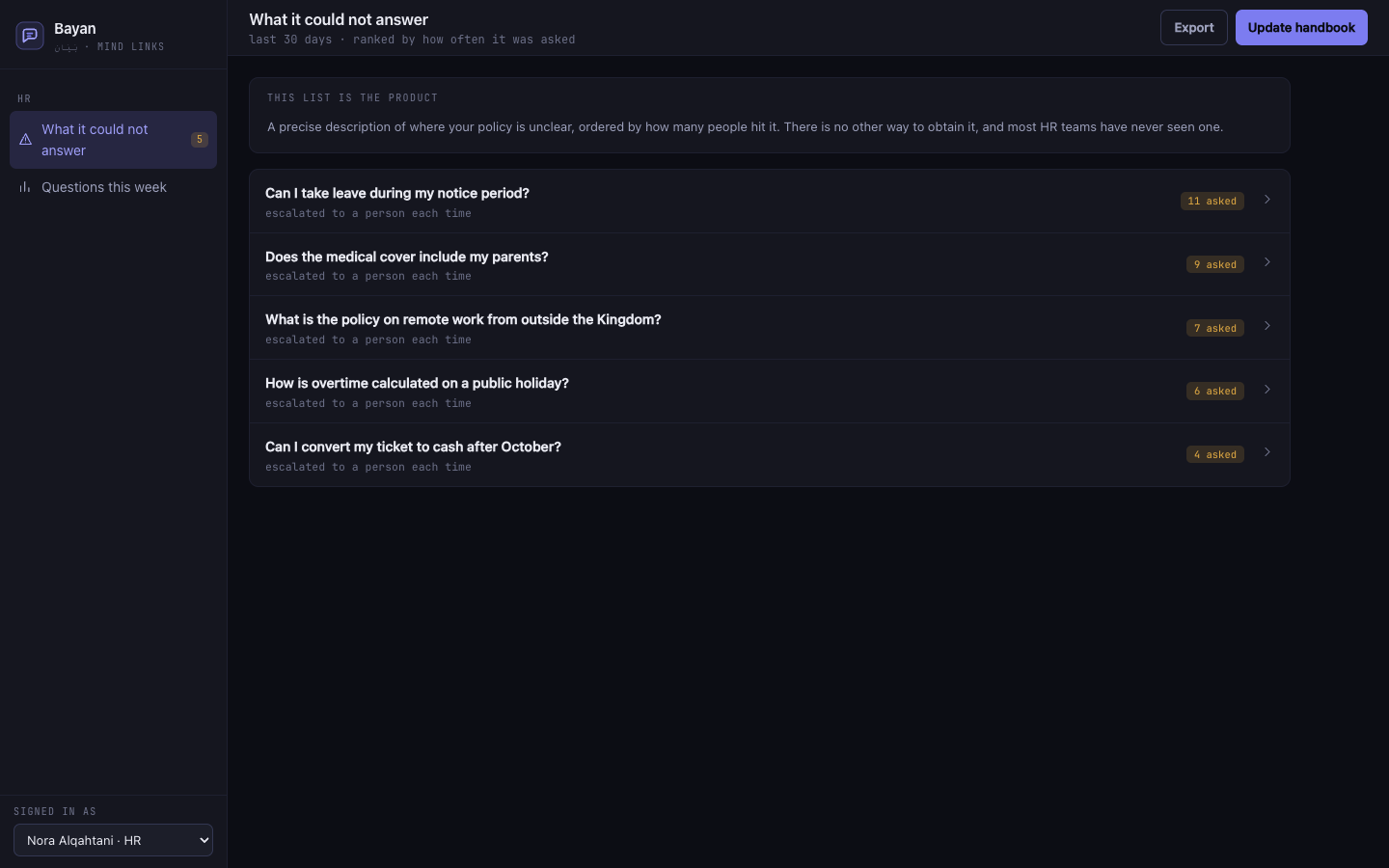
Screenshots of Bayan, a working prototype we wrote for this page. It runs, every figure in it is invented, and we will click through it in a meeting.
Grounded, or silent
If the policy does not cover the question, it says so and offers a human. It does not reason its way to a plausible answer about somebody’s end-of-service payment. That restraint is the whole product.
It knows who is asking
Contract type, length of service, location and grade change the answer. A question about leave has a different answer in year one than in year six, and the assistant reads the employee record before it reads the policy.
Threads by subject, not one long chat
Leave, medical, travel, payroll, policy. A person returns to a thread six weeks later and it is still there, with what they were told and when.
Handover with the context attached
When it escalates, HR receives the question, the answer given, and the clause used. No one starts the conversation twice.
What HR gets, which is the actual sale
A weekly list of what people asked and what the assistant could not answer. That list is a precise description of where the policy is unclear, and it is not obtainable any other way. Most HR teams have never seen it.
03 — The Saudi part
The questions are specific, and so are the answers
| What gets asked | Why a generic assistant gets it wrong |
|---|---|
| End-of-service benefit | The calculation depends on resignation versus termination and on years served, and it is set by the Labour Law rather than by your handbook |
| GOSI deductions | The rate differs for Saudi and non-Saudi employees. An answer that ignores that is wrong for most of the workforce either way |
| Iqama and exit-re-entry | Renewal timing, who pays, and what happens to leave while it is processing |
| Annual ticket | Entitlement, family members, and whether it is cash or a booking — almost always a company-specific clause |
| Ramadan hours | Reduced hours are statutory for fasting employees. Who they apply to is the question people actually ask |
| Leave carry-over | What lapses at year end, and what is paid out |
Arabic is not a translation layer here. A worker asking about end-of-service in Arabic must get an Arabic answer quoting an Arabic clause. If the policy exists in one language only, the assistant says which language the source is in rather than translating a legal document on the fly and presenting the result as policy.
PDPL applies from the first question. These conversations contain salary, medical and family detail. Where the transcript lives, how long it is kept and who can read it are agreed in writing before the first employee logs in.
Built with, and where it runs
- Google Cloud · Dammam
- Retrieval over your own policy
- Arabic and English
- Qiwa · Mudad
- Data stays in the Kingdom
The highlighted regions are live in the Kingdom today. Hosting is settled before the software is, because PDPL and your own client contracts settle it — not us.
04 — What we would build first
One month, one topic
In the first month
- Leave only — entitlement, balance, carry-over, the request route
- Your actual policy loaded, in the language it exists in
- Every answer carrying its clause
- Escalation to a named HR person with the context
- The weekly list of what it could not answer
Deliberately not yet
- Payroll, medical and end-of-service
- Writing back to the HR system
- WhatsApp as a channel
- Anything that takes an action rather than answering
Leave is the highest-volume topic and the lowest-risk one. If it does not earn trust there, it should not be allowed near end-of-service.
Whose software this is
Ours. Designed, written and owned by Mind Links. There is no client behind it.
Our engineers have built assistants of this kind for large organisations, and those belong to those organisations. Nothing from them appears here. What carries over is knowing that the hard part is not the model — it is refusing to answer when the policy does not say.