Our own software · built and owned by Mind Links
A support assistant that knows when to stop.
Arabic-first customer support that answers the repetitive eighty per cent and hands over cleanly, with a dashboard that shows exactly where it failed.
- Sector
- Retail, clinics, services, utilities
- Channel
- WhatsApp first, then web
- Type
- Assistant plus supervision dashboard
- First release
- One month
01 — The problem
Two people, nine hundred messages, the same six questions
Where is my order. Are you open on Friday. Do you deliver to Al Kharj. How do I return this. Is the invoice VAT-inclusive. Can I change the appointment.
Answering those consumes a support team's whole day, which means the messages that actually need a person — a complaint, a warranty argument, a customer about to leave — wait behind them.
The reason most support bots fail is not that they answer badly. It is that they will not admit when they cannot, and the customer has to fight the machine to reach a person.
02 — The system
Built around the handover, not around the answer
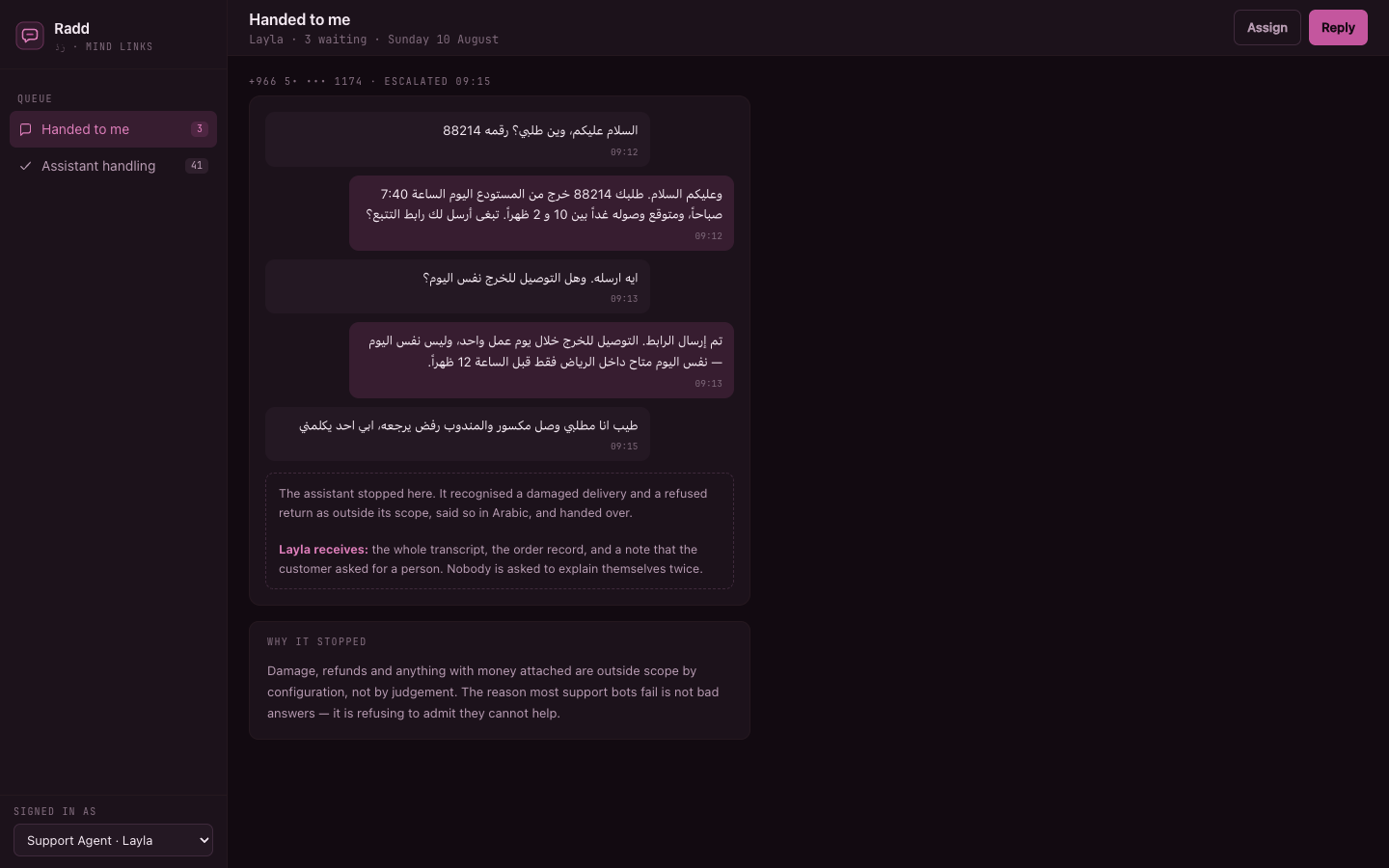
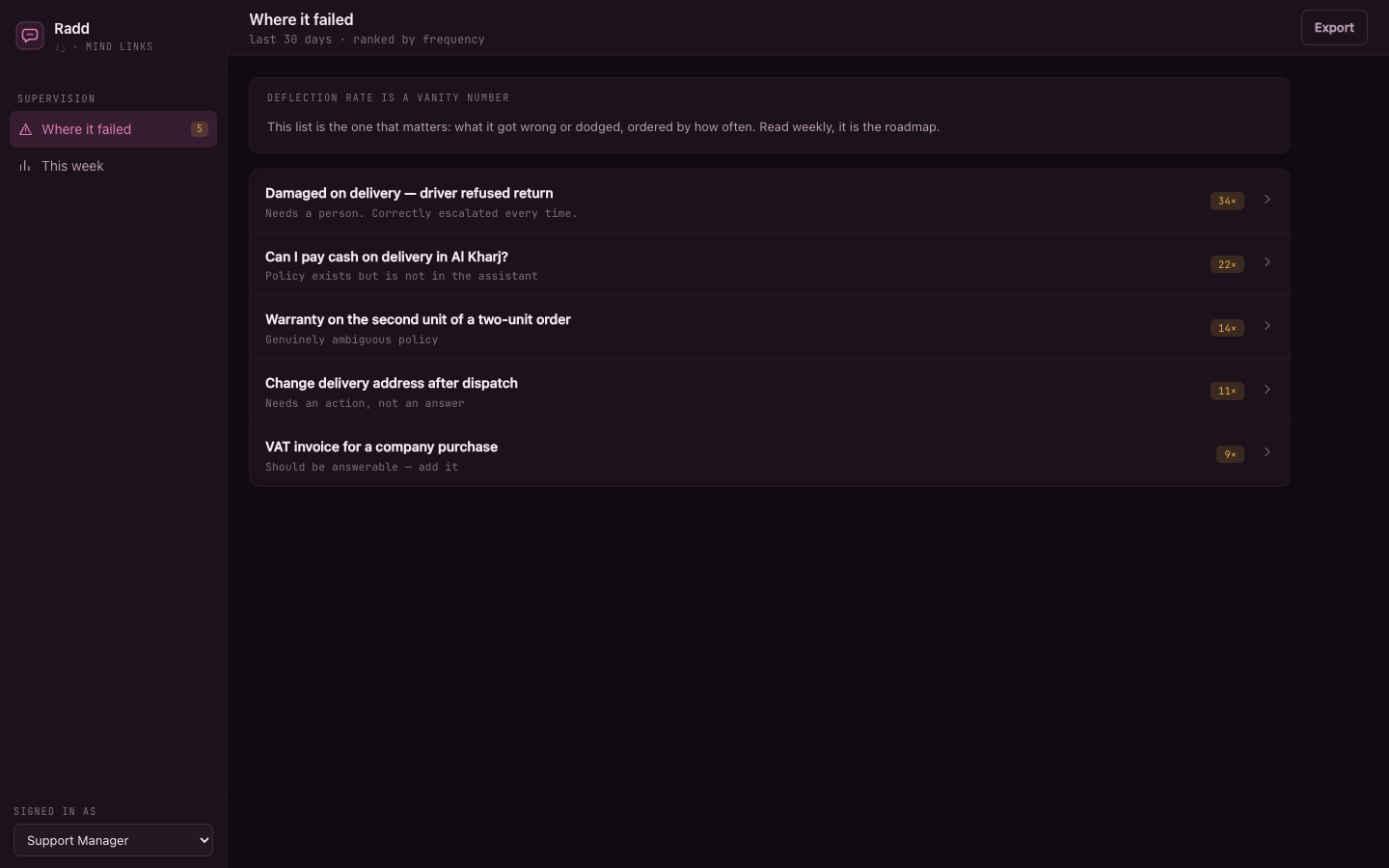
Screenshots of Radd, a working prototype we wrote for this page. It runs, every figure in it is invented, and we will click through it in a meeting.
Escalation is one message away, always
“A person, please” works at any point, in either language, and it works on the first attempt. No loop, no let me try once more. A customer who has to argue with a bot is a customer telling somebody about it afterwards.
It hands over the whole conversation
The agent picks up with the transcript, what the assistant answered and what it was unsure about. Nobody is asked to explain themselves twice, which is the thing customers actually hate.
It refuses outside its scope
It answers from your policies, your hours, your delivery areas and the order record. It does not improvise about a refund, a medical question or anything with money attached.
The dashboard shows failures, not volume
Deflection rate is a vanity number. What matters is the list of questions it got wrong or dodged, ranked by frequency, read weekly by a human. That list is the product roadmap.
03 — The Saudi part
Arabic, and the kind of Arabic
Customers write in Gulf dialect, in Modern Standard Arabic, in English, and very often in all three inside one message with the product name in English and the complaint in Arabic. An assistant that handles only formal Arabic handles almost nothing.
| Detail | Why it decides whether this works |
|---|---|
| WhatsApp is the channel | Web chat is where support goes to be ignored. In this market first contact arrives on WhatsApp and the assistant has to live there |
| Right-to-left rendering | Mixed Arabic and Latin in one message, with order numbers and prices, is where naive implementations produce nonsense |
| Sunday to Thursday | “We are closed, back tomorrow” is wrong on a Thursday evening, and the assistant is the one saying it |
| Ramadan hours | Different opening times and different delivery windows, for a month, every year |
| VAT and the invoice | Price questions need the ZATCA position stated correctly, because the answer is a commitment |
PDPL applies to the transcript. These conversations carry names, phone numbers, addresses and sometimes health detail. Retention and access are set before the first message, not after the first audit.
Built with, and where it runs
- WhatsApp Business API
- Unifonic · SMS fallback
- Arabic dialect and MSA
- Google Cloud · Dammam
- Mada and SADAD order lookup
The highlighted regions are live in the Kingdom today. Hosting is settled before the software is, because PDPL and your own client contracts settle it — not us.
04 — What we would build first
One month, six questions
In the first month
- The six questions that are genuinely most of your volume — counted from your actual message history, not guessed
- Arabic and English, on WhatsApp
- Instant escalation with the transcript attached
- The weekly failure list
Deliberately not yet
- Order-system integration
- Taking actions — cancelling, refunding, rebooking
- Voice
- Anything about money or medical advice
Six questions answered reliably beats sixty answered approximately, and it is the version your support team will defend rather than resent.
Whose software this is
Ours. Designed, written and owned by Mind Links. No client behind it.
Our engineers have built support assistants and their supervision dashboards for large operators. Those belong to those operators and nothing from them appears here. What carries over is the finding that the escalation path, not the answer quality, decides whether customers accept the thing.