Our own software · built and owned by Mind Links
Planned downtime, and what it really costs.
A year of maintenance windows on one timeline, planned against actual, so the meeting about the overrun starts from a number instead of a memory.
- Sector
- Manufacturing, facilities management, logistics
- Company size
- Anyone running more than three sites or lines
- Type
- Planning and variance tracking
- First release
- One month
01 — The problem
Everyone agreed the date. Nobody agreed the cost.
Planned downtime is the one cost a plant or a facility can actually control, and it is almost always tracked in a spreadsheet that one person owns. The window is agreed in a meeting in November. It moves twice. It runs four days long. By March nobody can reconstruct why.
The failure is not the overrun. It is that the overrun leaves no evidence, so next year the same window is planned with the same optimism.
The question that has no answer today: which of our maintenance windows ran long last year, by how much, and what did that cost in output?
- The plan lives in one person’s fileWhen they are on leave, the answer to “can we take line 3 down in week 14” is a guess.
- Clashes are found lateTwo windows overlap, or a window lands on the week the annual audit arrives. Both are visible months in advance and neither is visible in a spreadsheet.
- Actuals are never written downThe plan is updated to match reality, which quietly destroys the variance.
- Contractors are booked against a moving dateMove the window and somebody pays a mobilisation fee, but nobody records who or how much.
- The monthly report is retypedThree days of somebody’s month producing a document that describes what already happened.
- Ramadan is remembered lateShorter working hours, a different shift pattern, and a window that was scoped on ordinary throughput.
02 — The system
One timeline, and a second bar under every window
The whole idea is the second bar. Every window is drawn twice: what was planned, and what happened. They sit one above the other, so variance is not a report you run — it is the shape of the picture.
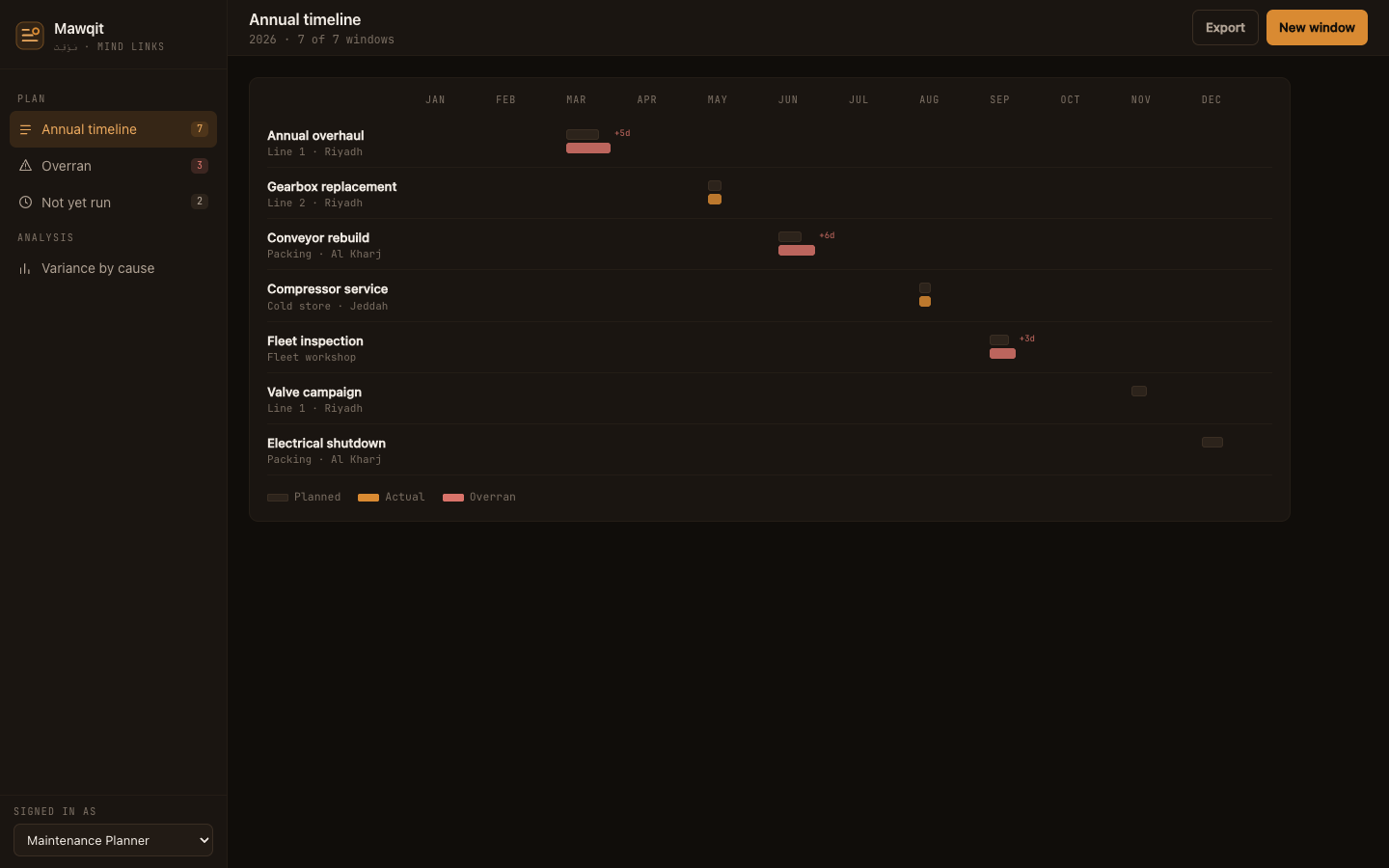
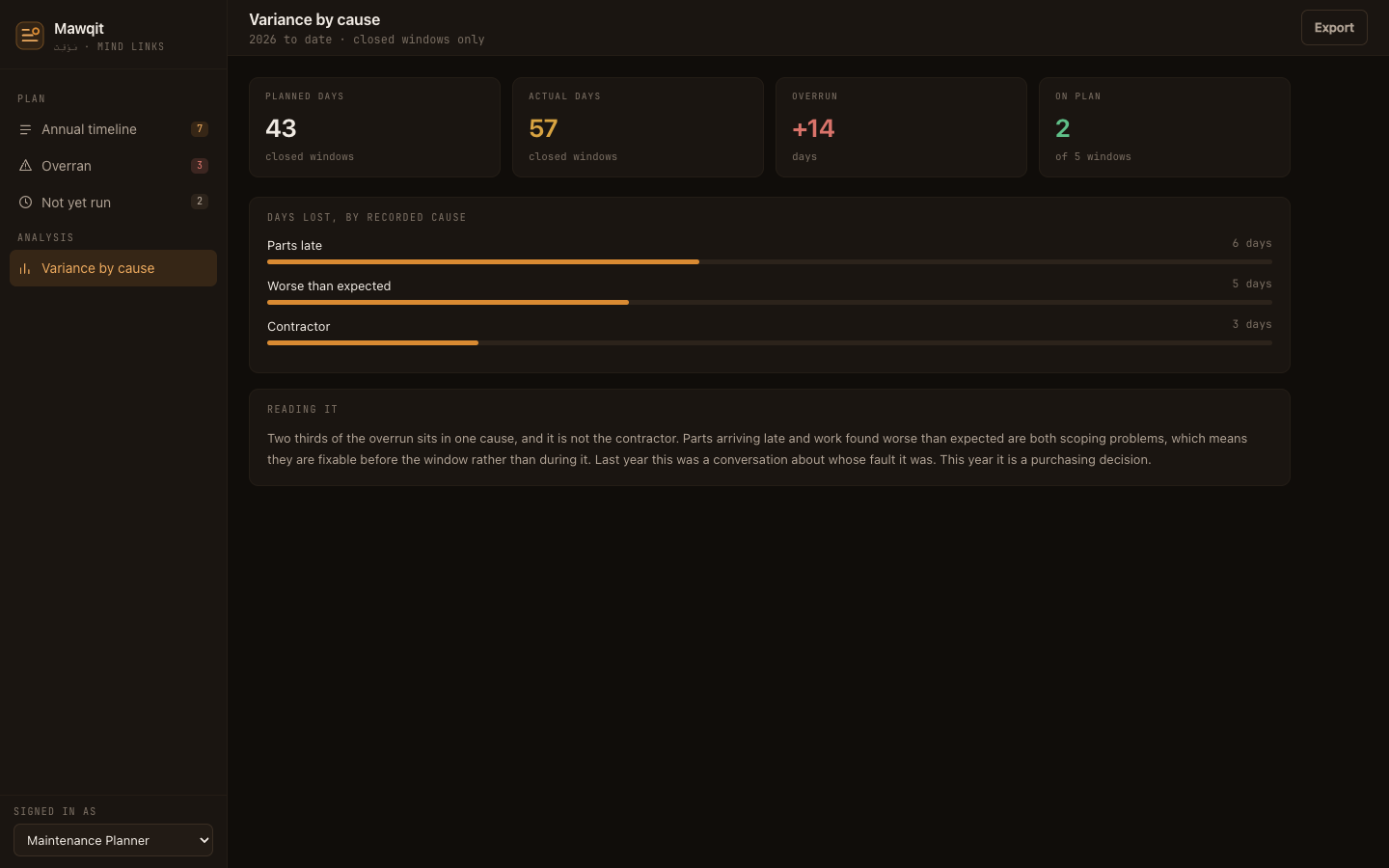
Screenshots of Mawqit, a working prototype we wrote for this page. It runs, every figure in it is invented, and we will click through it in a meeting.
Planned against actual, permanently
Editing a plan does not overwrite it. The original stays, so the archive answers “how good are our estimates” a year later, which is the only question that improves them.
Clash detection that knows your calendar
Not only other maintenance. Ramadan hours, the Eid holidays, the external audit, the quarter-end close, and whatever your busy season is. You load those once.
A cause on every overrun
From a short list you agree: parts, contractor, scope grew, found worse than expected, weather, permit. Free text is optional and the list is not. Six months of that is the first honest analysis of your maintenance the company has ever had.
The monthly report generates itself
What was planned, what ran, what slipped and why, ready on the first working day. Nobody assembles it, so nobody is three days late with it.
03 — The Saudi part
The calendar is not a detail here
A scheduler built elsewhere assumes a Monday-to-Friday week and one set of public holidays. Ours starts from Sunday to Thursday, Ramadan hours, and two Eid periods whose dates move each year against the Gregorian calendar the plan is drawn on.
Contractor availability is the other half. A window that depends on a subcontractor whose GOSI certificate or insurance expires mid-window is a window that will stop. If you also run the contractor approval system, the scheduler reads that register and refuses to book a supplier whose documents lapse before the finish date.
Built with, and where it runs
- Google Cloud · Dammam
- GOSI certificate check
- Hijri and Gregorian calendars
- WhatsApp Business API
- CSV and Excel import
The highlighted regions are live in the Kingdom today. Hosting is settled before the software is, because PDPL and your own client contracts settle it — not us.
04 — What we would build first
One month, one year of history
In the first month
- Last year’s windows loaded from whatever you have, including the spreadsheet
- The timeline, planned against actual, on a screen a manager can open on a phone
- Clash checking against your real calendar
- One number: total planned days against total actual days, by site
Fixed price. Source code yours from the first commit.
Deliberately not yet
- The approval flow
- Contractor booking and cost capture
- Integration with the maintenance system
- Automated monthly reporting
All of it is easier once a year of real history is in and people trust it. A planning tool nobody believes is a second spreadsheet.
Whose software this is
Ours. Designed, written and owned by Mind Links. There is no client behind it and every figure in it is invented.
Our engineers have built scheduling and variance systems at considerably larger scale, for organisations that own those systems. Nothing from them is reproduced here — not the code, not the screens, not the process. What carries over is knowing where this kind of system breaks.